Thursday, May 04, 2006

Done with second year!

Finished up my last exam yesterday, and so I'm two-thirds done with law school! Unfortunately, that means that I have only a few days left to explore Tokyo. I'm headed to Beijing on Monday and staying through Saturday and then leaving for home the Monday after that. While walking around Shibuya the other day, I was definitely a bit crestfallen to be leaving this incredibly exciting city, but it will also be nice to be able to drive through empty spaces again and return to beautiful New England.

But I will be happy to leave the traditional law school studies behind for a summer, along with the ambitious, and yes, manipulative, law school types that go along with it. For now, I will revel in the glow of freedom and the ability to read the books I please, to write a bit, and to learn whatever I like.

Labels: ,

Tuesday, April 25, 2006

Eating up my courses!

Well, I've finished three of my six classes: International Commercial Arbitration, East-West Negotiation, and International Taxation. It's definitely a load off, but I will feel tons better after finishing tomorrow's International Commercial Transactions class. The buzz of being halfway done with my coursework for the semester and picking new courses for next year was effectively ruined when a received a memo from a Temple law prof telling me that studying in Japan has "eaten up" 16 of my apparently available 18 credits, telling me that I should have taken Civ Pro II, Crim Pro, Corporations, Taxations, Sales, and Political and Civil Rights in my second year like everyone else, alongside even more bar courses in 3L. Apparently, I must be frittering even more credits away with law journal. Oh, the humanity!

What a waste of space I am! Hee!

Labels:

Friday, April 21, 2006

Thoughts on the last day of classes

So today is my last day of classes at TUJ. I usually use this blog to post experiences and observations about my travels in Japan and Asia, but I can't forget that the main reason that I'm in Tokyo is to study law and learn more about international law in particular. Lawyers are infamous for greediness, selfishness, and pomposity, and like almost all stereotypes, there is some truth to that statement, but not without cause. Most of us have given huge chunks of our lives up to studying and have large amounts of debt from tuition bills and living expenses for seven years, many of us wondering whether the enormous investment of time, energy, and money has been worth the all-nighters, the wrangling over unfairly curved grades, law journal cite checks, etc. Therefore, it is only natural that many lawyers feel like they rightly deserve to make a very comfortable living and accumulate wealth for the future and for their families.

This semester, I've taken a host of classes focusing on international corporate transactions, negotiations, arbitration and taxation. Sometimes I get questions from friends who know that my passion is human rights, rooting out corruption in government, and bringing justice to those who commit horrific crimes like genocide and starving their own people in order to get richer. "Are you going to be a corporate lawyer, now?" they ask. The answer is no, but with clarifications.

Non-profit organizations do much to help individuals without voice or means to litigate a dispute. However, my main criticism of some non-profit organizations and NGOs is an overreaching idealism, spurning the study of and negotiation with institutions like large corporations, simply because they do not agree with the whole idea of corporate profit-taking without giving anything back to people. And I agree that corporations usually consist of people from the upper eschelons of society, and they often have more respect, rights, and power than the vast majority of ordinary citizens whose rights and freedoms politicians are bound to protect under the Constitution.

However, overreaching idealism and ignorance of corporate operations and law promotes an us vs. them approach to dealing with multinational corporations, a tact that is silly and ignores the present entrenched power structure in society. I advocate pragmatic idealism instead: It is better to learn more about corporate dealings and appeal to the better nature of executives who have a conscience and those who believe that, not to sound superheroeish or cheesy, but with great power comes great responsibility.

And so, when I hear a classmate compare the intellectual property rights of the Walt Disney Company, a cartoon studio, to the intellectual property rights of pharmeceutical companies who have in their possession the patents of thousands of life-saving drugs that could end the suffering of millions of poor people all over the world, a little part of me dies inside. And then, to hear a professor, another person in a position of power, advocate that stance and stifle all discussion to the contrary with the statement, "Hey, pharmaceutical companies get a bad rap! Why criticize them? They're just out to make money like everyone else!" it's almost impossible to bust out in a fit of rage.

So I need to get this out: Don't live up to your stereotypes. Some lawyers genuinely love crunching numbers, advising on business transactions, and negotiating big deals, and that is wonderful. But when the almighty buck begins to cloud your view of humanity and darken your soul, that's when there is a problem. Attorneys are put into a powerful position in society; some were born into this position and some had to fight and work tooth and nail to get there, but regardless of where you started, please recognize that the greatest attorneys, the ones who are remembered years and years from now are the ones that advocated for the people. Corporations may dissolve, shareholders may opt out, but it is not the same as a person dying despite there being live-saving medication in the world to ease their pain.

And that is my piece.

Labels:

Monday, February 06, 2006

Supreme trip


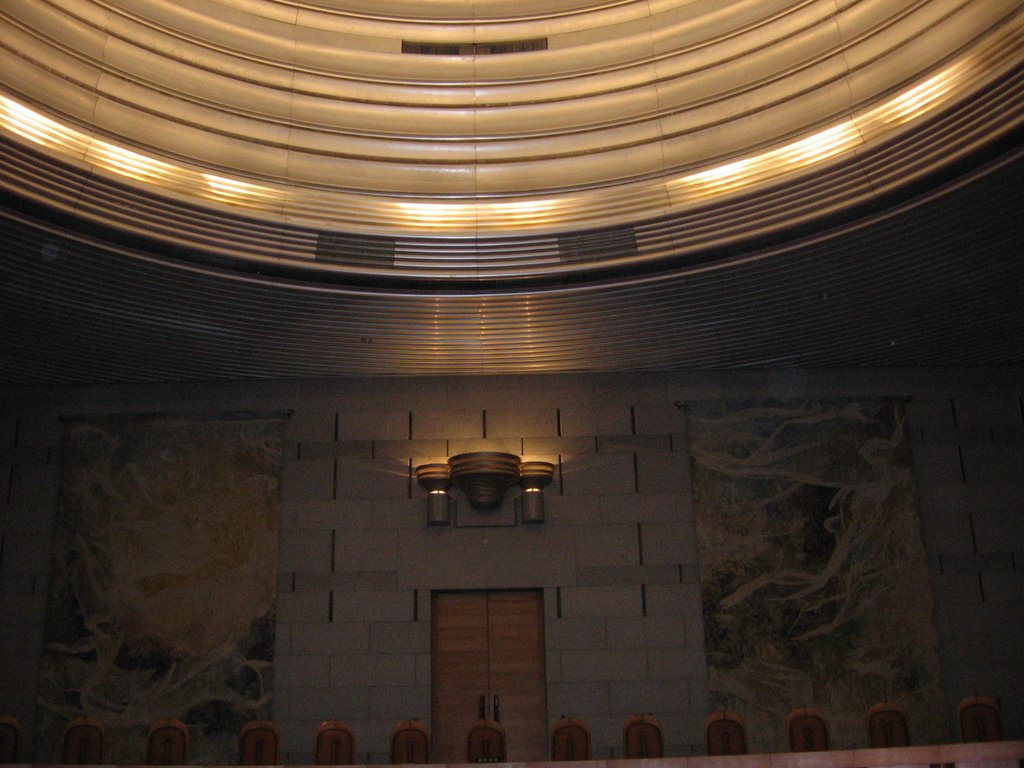
We TUJ law students were lucky enough to get a guided tour of the Supreme Court of Japan last week, complete with a Q&A session with the most senior of the Supreme Court justices, Justice Hamada, who is very generous with his time with visiting American law students. We were not allowed to take many photographs, but for a virtual tour, you can visit here.

In Japan, the court system is composed of four tiers, 438 summary courts at the bottom level, 50 family courts and 50 district courts next, followed by 8 high courts and the Supreme Court in Tokyo. Supreme Court justices hear two different kinds of appeals: Jokoku appeals, which deal with appeals of the judgments of the lower courts and special criminal appeals; and kokoku appeals, which are issues of the constitutionality of particular legislation. Decisions may be rendered by the Grand Bench, but usually only in cases of very important kokoku appeals. Usually, cases are dealt with by one of the three petty benches (dealing with civil, criminal, and administratie/patent law) with five justices each. The Chief Justice is chosen by the Emperor with the consent of the cabinet and the remaining 14 are appointed by the cabinet but is reviewable by the public by a popular vote after appointment. Ten of the justices must be either lawyers by trade (usually bengoshi that have distinguished themselves by becoming the head of a bar association) or professional judges, prosectors, and law professors. Justices are required to retire by the age of 70.

Justice Hamada was such a nice man, and it was easy to forget that we were speaking with one of the most powerful and influential people in Japan since he had such a calm and easy manner. He spoke a bit about the appeals process and was particularly interested in how the U.S. Supreme Court is able to get away with hearing so few cases, when the Supreme Court of Japan is inundated with appeals, making the work somewhat tedious and very harrying. He also spoke about rendering dissents, and how when he first started, his colleagues wished him good luck by telling him to write a powerful dissent, but since then he noted that it wasn't so great to be involved in a dissent.

Dissenting opinions in Japan are not common or as well respected; however, I was able to ask Justice Hamada about the most interesting case he has been involved with, and he answered that he was actually included in the dissent of a number of voting malapportionment cases. Voting apportionment is a huge deal in Japan, as the method of electing members of the Diet, or the legislature here, is done in such a way that a vote in Hokkaido or in rural Japan can be worth as much as three times as much as a vote in heavily populated Tokyo or Osaka, leading some to contest the constitutionality of such a system. The Supreme Court has overturned some more egregious cases of malapportionment (and has subscribed a 3:1 maximum "vote weight" ratio) but has never invalidated an election.

The Supreme Court buiding itself resembles a post-modern palace of sorts with thick concrete walls and extremely high ceilings. Surprisingly, there are not many photos or paintings of the justices, and very few national symbols of Japan. The artwork is mostly confined to tapestries (see "Sun" and "Moon" tapestries above) and some simple paintings rendering attributes such as wisdom, courage, and compassion, considered to be integral to the justice system, which are hung in the Supreme Court library. My favorite part of the architecture was the huge dome over the Grand Bench.


Labels: ,