Sunday, January 07, 2007

A Tokyo Gaijin Survival Guide

Hi everybody!

It's your favorite TUJ alum, a bit misty-eyed at knowing that her good friend will be leaving for Japan tomorrow. I know a few people stumble onto the website from time to time, so maybe someone will read this Tokyo Survival Guide?

I'll try to update as I think of things and if you have any questions just ask or feel free to browse the rest of the blog!! Dozo!

1. The Metro is your friend. The first thing I did on the plane was memorize the Tokyo Metro and JR Yamanote maps. It's the best thing I did, because it allowed me to hit the ground running, so to speak. The subway signs and maps are the best English you will see in Tokyo too, so it's comforting. You can even download it to your video iPod now. Awesome. Don't plan on taking a taxi ever as they are incredibly expensive.

2. Don't spend every night in Roppongi. Seriously. Don't. Roppongi can be nice on occasion. The beer tastes familiar, there are Western style eateries, you'll see a lot of Caucasian faces. But is this why you came to Japan? There are plenty of fun things to do in Shibuya, Shinjuku, Meguro, Gotanda, and so on. Yes, it's close to TUJ, but you'll be missing out on the izakayas and punk clubs in favor of the seedy bars populated by Aussie expats and Russian prostitutes. Some of the most interesting nights I spent were those in which I spoke with locals: not your classmates and certainly not those gross, horny white businessmen.

3. Tokyo doesn't need to be THAT expensive. The combinis are the best deals in Tokyo. You can buy some udon or soba, cut up some bok choy and carrots (that they also sell there), scramble some eggs, pour on some hot sauce, and make a perfectly good meal. It's best to eat your big meal at lunch, since most restaurants offer good set deals and a ton of food that will cost at least three times as much at dinner. Temples are free to visit, and the best part of Tokyo, walking around and window shopping, etc. is free. If you buy your beer in the combini, it's also much much much cheaper than going out to a bar. Save your money to travel. If you run out of money and have to nix that trip to Kyoto? Gah!

4. Watch out for the mayonnaise. That goopy stuff on your chicken. Yum. Looks like cream sauce. It's mayonnaise. Want some pizza with a tasty white sauce? Nope, mayonnaise. With corn. Delish. The little surprises baked in the middle of things can be fun, but can also be like having some Bernie Bott's Every Flavor Beans.

5. Eat Japanese Food! It's delicious. The Shabu Shabu place they take you on your first night of TUJ is gross. Do yourself a favor and get some good shabu shabu. And some okonomiyaki. And sushi at Tsukiji. Anmitsu in Asakusa. Department stores also have good restaurants on their top floors. Try it all. You'll miss it when you're back home.

6. Spread out your sightseeing. Don't run all around Tokyo at once. Save some trips for later on so that you have something to do later on in the semester. I made that determination earlier on in the semester, and it was one of the best that I made. I did the biggies first: Harajuku, Shibuya, Shinjuku, Ginza and then saved trips to Asakusa, Tokyo Station, Ueno, and others until later. It definitely made things a lot more interesting.

7. Take advantage of the TUJ language courses. The most upsetting thing was how many people paid for and then subsequently dropped out of the language courses at TUJ. People don't speak as much English as you might expect in Japan, and the more phrases you learn, the better off you'll be and the more respectful you will appear to Japanese people. I learned more from my erudite roommate and the TUJ language courses than in most of the law classes. Sorry! It's true!

Also, you might be approached by students hoping to improve their English by speaking with you. Usually, they're harmless. You might get a free meal out of it if you're willing.

8. ATMs. Most ATMs will not work with foreign cards. You can use the Citibank ATMs and the ATMS at the yuubin kyoku (post offices). Plan accordingly! Also, most restaurants and even some stores will not take credit cards. Japan is not a credit card culture like in the States.

9. Experience the culture. Go to a ryokan. Go to a sento or onsen. Watch the terebi, even if you don't understand. Don't be a Ropponger. The kawaii-ness might freak you out a bit at first, but it'll grow on you. Rejoice in the bizarre!

10. Clerks in Japan are way more attentive than in the States. Enjoy it and try not to be freaked out like I was. Irashaimassseeeeeeeeeeeee!

11. You might be stared at. Especially if you have breasts or blonde hair. It's a bit disconcerting at first, but usually it's harmless. Just try to look away and if it continues, a few choice phrases can usually throw them off.

12. Grab the ads! Free tissues! Yay!

13. Combini culture. You will bring a meal over to them. They will say something to you in Japanese. They're asking whether you want it heated. Then they'll ask if you need hashi (chopsticks). The donburi and onigiri are good. You just need to figure out which ones are full of sea urchin and which ones have good things like salmon and tuna. It's almost always usually cheaper to go to the combini than a full-fledged supermarket. The produce is less expensive at specialized fruit shops as well. Have your family ship peanut butter and other goods from the States if you need them. They are SO much more expensive than the Japanese brands.

Labels:

Thursday, June 01, 2006

Top Ten: Favorite Days in Japan

Aww, since I'm back in Philly, I'm getting nostalgic over here... But I have to proceed...

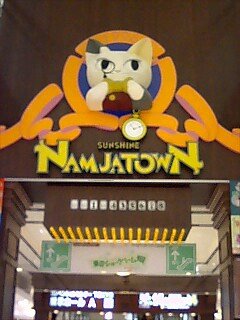
10. Ikebukuro wackiness: The wackiness was interminable at Ikebukuro on a really rainy day. First we headed out the exit and saw a Cafe Du Monde, the famous beignet and chicory coffee shop from New Orleans, went to one of my favorite stores in Tokyo for more wonderful Japanese pens, and of course, at Namco Namja Town, we saw the scariest toilet in the world, ate ice cream at Ice Cream City (complete with the insane array of flavors in the museum!) and free dumplings at Gyoza Stadium. The craziness refused to stop. You know I love that.

9. Anime festival: This would be higher if there were more freaky otaku and costumed manga crazies, but alas, no. But the sheer magnitude of this ode to anime was worth it, along with the cheap cels, the free useless swag, the awesome mini-concerts and readings, and the costumed babes that looked like they'd rather be working at Lawson's. The night was topped out with some conveyor belt sushi, and who can argue with that?

8. Clubbing, bar-hopping haze: I know there was one particular day when we went to no fewer than six bars in a haze of Japanese debauchery, but don't ask me to give you the details both for my own honor's sake and for my bedraggled memory's sake. I will say that I sang the Celine Dion song from Titanic karaoke-style for a round of drinks and waited in the freezing cold and snow for the best sushi on earth. The rest of the blanks have to remain blank.

7. Kanamara matsuri: Rum and cokes at 10 a.m. in front of guys carving penises out of daikon radish, sausage vendors, and the lollipops. Seriously, this fertility festival was a serious affair for some, but for most it was an excuse to bring out your inner phalliciousness. Afterwards we wandered around Yokohama's Chinatown and while the Chinese food was nothing to write to China about, it was still a fun way to cap off the day. Oh wait, I basically capped it off by incessant giggling . . . "I just went to A PENIS FESTIVAL." Good times.

6. Meeting with Justice Hamada: Second Supreme Court justice I have met, after Ruth Bader Ginsburg at Brown '02 Commencement. It was wonderful to tour the Supreme Court of Japan and meet an amazingly humble man like Justice Hamada.

5. Harajuku, Shibuya, & Meiji jingu (first week in Tokyo): Jet-lagged and bereft of any knowledge of Japanese (but having memorized the subway system already), it was a beyond gorgeous day in January (maybe about 58 degrees) and I headed off to Harajuku on a Sunday. I remember walking, walking, and walking, armed with my Time Out guide and my Tokyo City Atlas and still incredulous that I was in Japan. I befriended some students from Waseda University, and they took me to a little underground café after I agreed to speak with them about America so they could practice their English. We ate the sickly sweet crepes that they sell along Takeshita Dori, the shopping street for Gothloli gear and then we bid farewell, leaving me to peruse Kiddyland, Snoopyland, LaForet, and to trek over to Meiji jingu, where I sat on a bench and people watched for awhile until I walked over to Shibuya just in time to watch the neon illuminate Hachiko at the JR Station. One of my first days, but still goes down in my memory as one of my favorites.

4. Nikko (Day One): Strolling around the UNESCO temples, meeting the friendliest Japanese boy imaginable (who drew my portrait) at a lunchtime restaurant, gorging ourselves on
shabu shabu for dinner and drinking Belgian beer after Belgian beer. (No offense to Asahi Super Dry, but you just cannot beat a Belgian white beer after a long day of walking!) Follow that with a comfy ryokan and drunken Scrabble, and you have the perfect weekend getaway.

3. Setsubun: I would guess that I was one of the few non-Japanese people at TUJ who actually knew what the heck Setsubun was, but having celebrated Setsubun every single year at college (Emi brought mame and the essential oni mask home from Japan every year after winter break), I needed to have the real Setsubun experience. I was a bit obsessive about this, as Jeremy might tell you, but it all worked out for the best as it was amazing! We wrestled our way through the crowd to grab crappy free stuff, I almost got maimed by a mochi flying at extremely high velocity, and I learned that Japanese senior citizens are just as passionate about their free swag as American seniors are. Ah, gotta love that WWII generation! Oni wa soto! Fuku wa uchi! After some tasty CoCo curry, the cute guy at the Peacock Daimaru florist stand gave me my own oni mask. Nice!


2. Hanami day: Jeremy and I caught the train to Kamakura, saw a not-so-large bell but made up for it with delicious amazake, hiked a trail over to Zeniarai Benten, the money washing shrine, got kicked out of a curry place (prompting me to yell like an idiot telling customers not to go in there in my broken Japanese) but made up for it with sweet potato ice cream. After which I met Rachel, Joe, and other classmates at Ueno Park for a hanami; I sat under the sakura, drank a lot of wine and Sapporo and liqueur (but not enough to incur a hangover), met some interestingly smashed Japanese women with a penchant for Jim Beam and some American, Canadian, and British English teachers. A quick trip over to Akihabara afterwards was worth it if only to see this guy and get the full-on otaku experience. I think if there is a quintessential day in Tokyo, this is it.

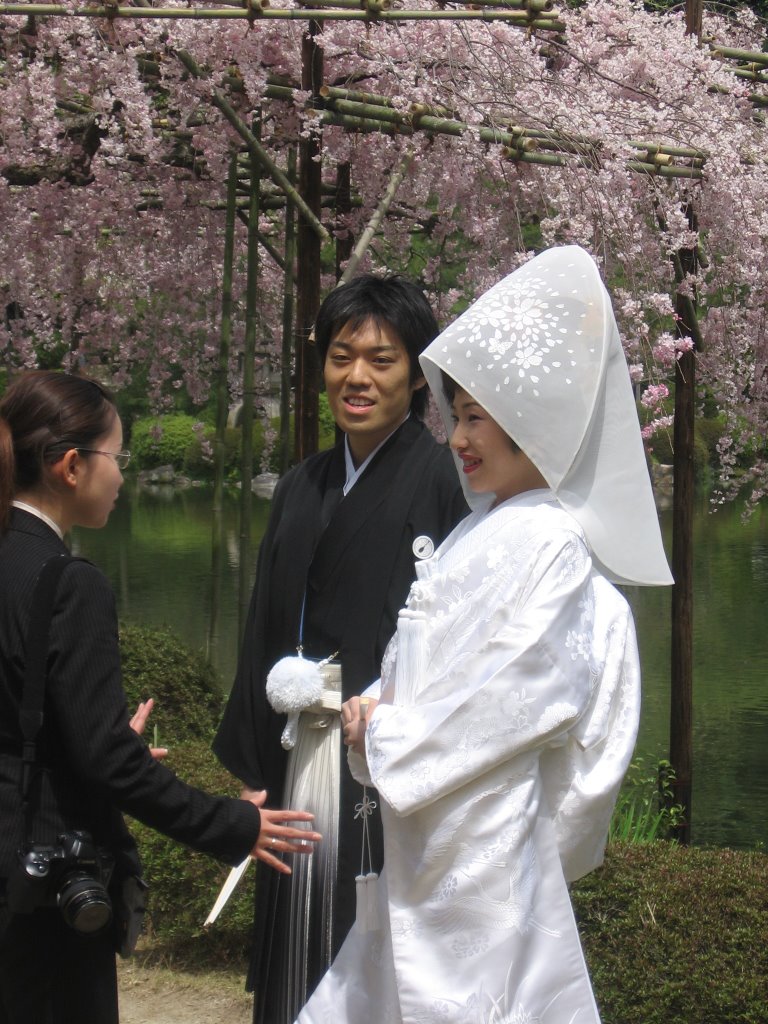
1. Kyoto: I guess this isn't just one day, but it feels like one long dreamy day and it's hard to pick one of the three days that Yvonne and I were there. Some examples: seeing geisha dashing to their appointments in Gion and a huge lit sakura ki in the park, the gorgeous Kinkakuji and Ginkakuji, walking the back trails to temples and practicing my Japanese, matcha ice cream floats and grilled dango and anmitsu and takoyaki, and finding cute little trinkets that I thought I would find in Tokyo, but could not. I'll go on: the spectacular view at Kiyomizu-dera and drinking the water that will hopefully help me to live to be 100, drifting down the sakura-laden Philosopher's Path in awe, the friendliness of the Kyoto people, bamboo forests and lush countryside, and Japanese brides and beautiful old women in heirloom kimono, and... Yes, I need to go back to Kyoto before I turn 30.

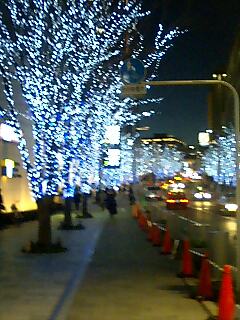
[Namjatown, Shibuya, and Roppongi trees taken by Rachel!]

Labels:

Thursday, April 20, 2006

Top Ten: Tokyo annoyances

List ni-ban! C'mon, of course I was going to make a list of things that are annoying ... don't you know me by now?

10. Crows are big, scary, and loud
You have never seen crows like the crows in Japan. They are huge, they are frightening, they poop everywhere, they swarm you if you have food, they pick at the garbage, AND to top it all off, they're extremely intelligent. Crows wake me up almost every day, but especially on non-burnable garbage day, when the very best of the food leftovers are ripe for the picking. Japanese crows are the things of nightmares, pure and simple. It's Hitchcock's The Birds come to life... Eeesh.


9. Porn on the train! No prob!
If you're the kind of person who can't wait till he gets home to get his daily fix of manga babes, sans clothing, then Tokyo is the city for you! Guys regularly bust out the hentai while headed to work and nobody blinks an eye. I usually enjoy glancing at what people are reading on the trains, but in Tokyo, that's impossible since bookstores provide free bookcovers to everyone making a purchase. Isn't it funny that it's the chikan that aren't afraid to hide what they are reading? A whole host of perversions (mostly bakunyuu or extremely busty babes) on display for grandmas and children to see! Hooray!

8. Kawaii desu ne!
Everything in Japan needs to be kawaii, the Japanese word for cute. That's why you'll often see that women in customer-service positions will put on a cute, high-pitched voice when welcoming you into a store or offering ads or free samples and the like. It gets grating after awhile, especially when you see grown women with dozens of stuffed animals or charms attached to their bag or keitai denwa. There are Pikachu on some airplanes, stamps with cartoon characters, and lots and lots of pink clothing with ruffles. It was intriguing at first, but I'm so over it now.


7. The perfect bag of garbage
"Garbage is the most important issue facing your neighbors," read the flyer that I was given when I moved into my apartment. "Lucky them!" I thought, thinking of the numerous issues back at home (break-ins, car theft, noise disturbances, domestic disputes, ad nauseum). The seriousness about garbage is crazy, as people take time to wash out every single can and sort things according to Burnable, Unburnable, and Recyclables and force everyone to put their garbage and clear plastic bags so that the trash collectors (and your neighbors) can see exactly what you're throwing out.

6. Let's individually wrap everything!
For a nation with claims of environmental consciousness, (see: Miyazaki films, Kyoto Protocol, Greenery Day) it sure is hard to find non-aerosol deodorant around here. And for all the anal retentiveness about separating garbage, there sure is a lot of excess waste to go around. You see that box of Kit Kats below? You need to open that box and then each of the four sticks of Kit Kat are individually wrapped. Same goes for pretty much any snack you'll buy, like crackers, cookies, etc. Even the fruit comes individually wrapped. You'll be hard pressed to find an apple without a styrofoam covering to prevent it from bruising. Lots of excess waste for very little reason.

5. The deliciousness is only temporary
While I posted earlier about the marvels of the konbini in Tokyo, I failed to mention that many of the items at the konbini are only seasonal, so you might find something wonderful one week only to find that it's gone the next. Case in point, Lawson's Station made an excellent fruit pudding, but it was discontinued after only a week and a half. In February, I found an tasty strawberry and cream bun, but never found it again. You'll see this with the Kit Kats too, especially. In Japan, the Kit Kats come in many flavors, shapes, and sizes and are popular gifts for students with exams, thanks to the Japanese phrase kitto katsu (I hope you will win). But the flavors are only available at certain times of year, so we have already bid farewell to the sakura- and wine-flavored Kit Kats in favor of melon and fruit parfait ones. Ahh, like the sakura, the ephemeral nature of tastiness is quite apparent in Tokyo, as the deliciousness comes and goes.

4. Obsessive much? (Annoyance hodgepodge)
Last weekend, I saw an entire television show dedicated to how to stop crows from picking at your garbage. Contestants had to invent ways to keep the crows from coming near the garbage, and
methods ranged from sprinkling hot pepper over everything, to a lifelike crow made from garbage bags complete with flapping wings, to a kawaii display of flashing lights and colors. Then they graded each method on various criteria, including an actual test with crows in a cage alongside some trash and the invention and a public democratic vote. Another TV show features water taste tests and details every single aspect of how much water you should have during the day. In Shibuya, there's an entire store dedicated to ranking items for sale called ranKing ranQueen. Now, I like a good top ten list as much as the next lady, but an entire store? Additionally, women obsess over their appearance and there's this secret battle to have the coolest keitai charms. And let's not forget the germophobia despite the prevalence of far greater health risks. See also:

3. Been spending most their lives living in the smoker's paradise
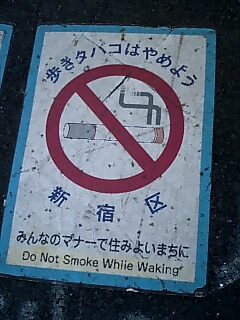
People love smoking here, despite the admonition to not smoke while waking. Ciggies are yasui (cheap), usually about 270 yen ($2.30) a pack and available from one of the numerous vending machines in the area. It's a wonder why there hasn't been more news about lung cancer, asthma, and other smoking-related illnesses. While there are the kinen patrols in Shinjuku and Shibuya to keep people smoking around the specially designed "smokers' oases" (natch!), it's mostly aimed at cigarette related accidents like burns, etc. (See my earlier post here.) Almost all restaurants allow smoking and very few have non-smoking sections, and even so, it's not uncommon to see people smoking in the non-smoking section and blowing smoke into their kids' faces. The Shinkansen ride that I took last weekend would have been excellent, were it not for all the smoke. In Japan, smoking is the habit that all generations have in common.


2. Kawaii girls won't give up their seats to the elderly
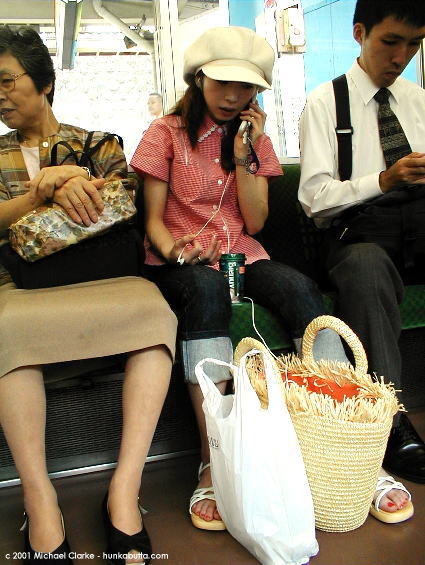
Konnichiwa, my kawaii friend! I see you there on the Yamanote line decked out in your layered tops, short little skirt, and high heeled boots. Both your makeup and your accessories are impeccable! And lucky you, you managed to snag a seat on the busy JR train. What's that? You're tired? I bet, after a day of hard shopping in those uncomfortable shoes. Better take a snooze. Or at least pretend to. Oh no, look, here's a little old lady with a shopping bag and extreme osteoporosis! You caught a look at her when you opened your eye just a teeny little bit to see if anything was going on. Better keep pretending to sleep or else you might be guilt tripped into giving up your seat... For a country with an aging population, the young people are not very deferential to their elders on the trains (I've seen 15-year-olds keep their seats when a blind woman was standing right in front of them). Maybe that's why a national holiday is needed to show Respect for the Aged (September 15).

1. Refusal to yield: You are the target
On the busy streets of Tokyo, it's easy to bump into people. But what is extremely annoying is the refusal of Tokyoites to move when they: a) see you; b) are moving directly towards you, and c) are about to collide if one of you doesn't move. It's like this gigantic game of chicken, and they're daring you to not move away. For all the rushing on the streets, once Tokyoites get to the train stations, it's quite okay to take a leisurely ride on every single escalator, however. But when walking at rush hour, more likely than not, you need to be the one to dodge or else you're going to bump shoulders or worse. It may sound harmless enough, but it's a tiring game that requires you to be on full alert. Abunai! Additionally, pedestrians have the right of way when it comes to motor vehicles, but NOT BICYCLES. Bikers ride on the sidewalks here and are the bulliers of the pedestrian world. You will be subject to that annoying little bell when a bike comes up behind you. When you hear it: DON'T MOVE, otherwise you're likely to invite the great pleasure of a front wheel up your ... behind.

[Photo credits: Scary crow from this blog, kawaii manga from this blog, ranKing ranQueen photo from Greggman, Kit Kats from Japan Newbie, kawaii girl from hunkabutta.com.]

Labels:

Wednesday, April 12, 2006

Top Ten: Tokyo conveniences

As my time in Tokyo winds to a close, (one month left!) I think it's appropriate to count down some of the top ten things that I've seen so far in Japan and in the other countries I've visited. So here goes list ichi-ban!

10. The hiru-gohan setto
Japan is expensive, but hiru-gohan (lunch) in Tokyo is surprisingly well-priced if you go for the setto (Set, natch! But don’t call it a “set.” They won’t understand you. It’s setto.) which are usually 1,000-yen or less (about $8) If you go for Italian, you get a big bowl of pasta, salad, bread, coffee and dessert. Traditional Japanese? A nice bowl of specialty rice with fish entrée, salad, pickles, and tea. Can’t beat it. You’ll pay three times as much for the same food at dinner.

9. You never need to buy tissues!

This might sound preposterous, but it is absolutely true. If you make a visit to the busier areas of Tokyo, such as Shinjuku and Shibuya, you can collect all the free tissues that you ever could possibly need. There are people employed to hand out advertisements near the Metro stations and along the busy roads, and sometimes these advertisements are on the outside of packs of tissues. It's far more likely that a passerby will take a free pack of tissues than a piece of paper. Suckers! I can't read your ad anyways! Which, come to think of it, is probably why sometimes they look pissed to give the tissues to gaijin like yours truly...

8. It’s a toilet seat, it’s a massager … it’s both!
You know the drill. You’re comfy in bed, it’s 3 a.m., and you have to pee. You slog out of bed, head to the bathroom, sit down, and gahhhh … that seat is cold! Not in Japan. The "Western" toilet seats here are a hoot for the unfamiliar. They have a seat heater, so your bum is nice and toasty while you sit and I found one with a massager as well. There are also some other buttons that may give you a surprise burst of water. There’s a “flushing noise” button that makes a fake flush sound so that people in the next stalls can’t hear you peeing. Pretty convenient, I’d say. But only if you can get a Western toilet … the Japanese toilets (a hole in the ground that necessitates girls taking off their pant leg) are markedly inconvenient.

7. Large bill, no problem It’s unthinkable to imagine sticking a $100 bill into a machine in the U.S., but in Japan, which is a cash-based society, you can go to the arcade, stick a 10,000-yen note in the coin machine and get back 10 100-yen coins, 4 1,000-yen notes and a 5,000-yen note. You can buy a Coke from a vending machine with a 1,000-yen bill. In the U.S., they’d kill you if you tried to buy a pack of gum with a $100. Here, no problem.

6. Health insurance cheap and easy
Japan's national health insurance system is a marvel. You walk into your local metropolitan office, fill out a form with your name, address, and salary, and you are signed up for health insurance. No worries about preexisting conditions, questions about family members, etc. They mail you your bill, which in my case, came out to a mere 800-yen a month. Speaking of…

5. Bill paying never looked so good
Instead of wasting time and money going to the yuubin kyoku (post office) for stamps, you can pay all of your bills (electric, gas, phone card, health insurance, etc.) at the convenience stores. They scan a little barcode on the bill, you pay, and they give you a receipt. Wicked easy, dude.


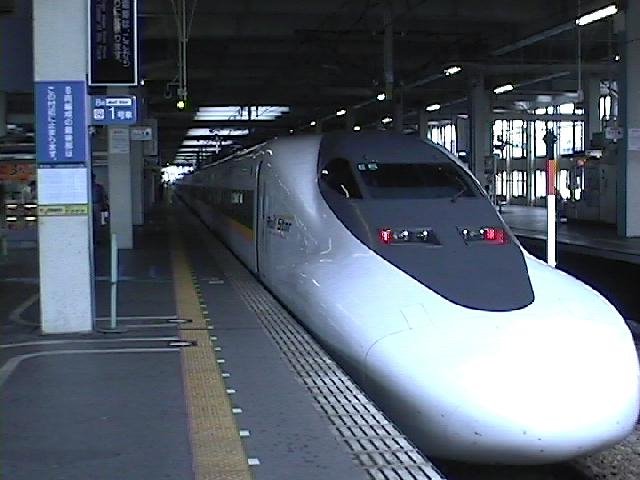
4. Fast train? You mean you've never heard of the Tokyo densha? Ahh, transportation in Tokyo... It's expensive, it's confusing, but man, when you figure it out, boy is it fast and convenient. Trains run all the time, sometimes less than five minutes apart especially on the JR Yamanote line. And the Shinkansen (bullet trains) are pretty famous. Trains here are almost never late and people freak out if they are, and the station managers hand out little slips which workers can give to their bosses as an apology on behalf of the railway company. Very convenient excuses, very convenient train lines. Not to mention that with dozens of train stations, you have to spend less time navigating Tokyo's inconvenient address-free streets.

3. Beer at your command
Ahh, the vending machines. They're curtailing some of these in the interests of Japan youth not getting their hands on ciggies and beer while underage (and there used to be vending machines featuring porn and other unsavories). But can you really beat vending machines that offer up beer at any time of day? What about HOT beverages and food? There you go.

2. Keitai denwa - Japanese cell phones rock the house
What can your cell phone do? My Japanese keitai denwa can scan barcodes, send emails, browse the Web, sent short messages to friends. It has an alarm clock that plays music, a calculator, a camera, a video camera, a calendar, a notepad, and the ability to look at images of the earth. And my cell phone was free. Keitai denwa are one of Tokyo's status symbols and more expensive upgraded versions can do even more. They act as mp3 players, GPS tracking devices, portable video game players, and so on and so on...

1. Good food, cheap prices at konbini - it's actually convenient!
We all know about Seven-Elevens in the U.S. They're horrible. The food in the refrigerator section is nasty, three-day old junk that's chock full of processed cold cuts and is horribly overpriced. If you want to run out to a convenience store because you forgot to buy mustard or cheese or something, you're going to pay twice as much (or more) for the same thing you get at the supermarket. Not in Japan! Some people do ALL of their shopping at the konbini, (or combini) which is unthinkable in the U.S. The best combini I have come across is right near my apartment, called the Daily Hot Yamazaki, which pairs up a bakery with a convenience store. You can get everything from batteries to wine and beer to batteries and office supplies to full meals here. And fresh bread and desserts as well. Lots of TUJ students eat their dinner at the konbini, because they serve full rice meals that are fairly tasty and they heat them up right there for you. Oh, and they're open 24/7.

[Credits: Toilet seat taken from Popgadget, Shinkansen at Denney-net, Me & My Keitai Denwa - photo by Rachel, Konbini art by H. Fuji]

Labels: